STEM participation in Australia is in troubling decline with Year 12 enrolments in Advanced Mathematics and Physics falling to record lows, according to the latest report from the Australian Mathematical Sciences Institute (AMSI).
Against this backdrop, Matthew Flinders Anglican College is committed to telling a very different story.
AMSI reports that nationally, higher-level mathematics participation dropped to just 8.4% and intermediate mathematics to 16.8% in 2024. National Year 12 Physics participation has also declined, falling from 14.9% in 2015 to 12.1% in 2023.
At Flinders, a strong culture of STEM participation is embedded across a wide range of subject offerings, encouraging curiosity, innovation and real-world problem-solving, explains Deputy Principal - Academics, Mr Bill Hooper.
“Our students’ Mathematics engagement is strong. Mathematics Methods is the most popular subject, with 60% of Year 12 students completing the subject in 2025, while enrolments in Specialist Mathematics have grown steadily to 29%,” Mr Hooper said.
“And in 2025, our Physics enrolments reached 31% of Year 12 students in 2025 – the highest since the introduction of the new QCAA syllabus – with consistently strong academic outcomes,” he said, noting the average Subject Median for Physics during the past six years was 92.25.
“Chemistry consistently attracts approximately 30% of students each year, while Engineering, one of the fastest-growing global disciplines, continues to rise at Flinders, now engaging 15% of our senior cohort.”
These subjects are widely recognised as essential foundations for future careers in STEM, making this a significant national concern.
A Culture of Strong STEM Engagement at Flinders
Strong STEM engagement opens a wide range of tertiary pathways for graduates.
The Flinders Class of 2025 secured offers across Medicine (7), Engineering (20) and Business-related fields (33), while nearly 40 graduates are entering health-related degrees including Nursing, Biomedicine and Pharmacy.
Principal Michelle Carroll said these tertiary offers reflect a culture where students are encouraged to challenge themselves, build confidence and pursue ambitious academic pathways.
“Over the past several years, and more recently guided by our Teaching and Learning Framework, Flinders has built a highly coherent approach from Prep through to Year 12, ensuring that our students experience a consistent, rigorous, low-variance curriculum at every stage of their schooling,” Ms Carroll said.
“That continuity means students benefit from a cumulative, well-designed sequence of learning that compounds over time,” she said.
“Our impressive NAPLAN and ATAR results stem from a deeply embedded culture of “warm demand”, which describes our learning environment where learners feel both challenged and cared for, and where effort, improvement and personal excellence are normalised.
“At Flinders, we are deliberate about what we teach, when we teach it, and how we teach it. This clarity gives students a stable, coherent learning experience from year to year, reducing guesswork and ensuring that every classroom is aligned to what the research tells us works best for student learning.
“Teachers across the school engage daily with evidence-based practice, applying it with consistency and purpose. Whether through explicit instruction, formative assessment or well-designed practice activities, our teachers bring the Science of Learning to life for students.”
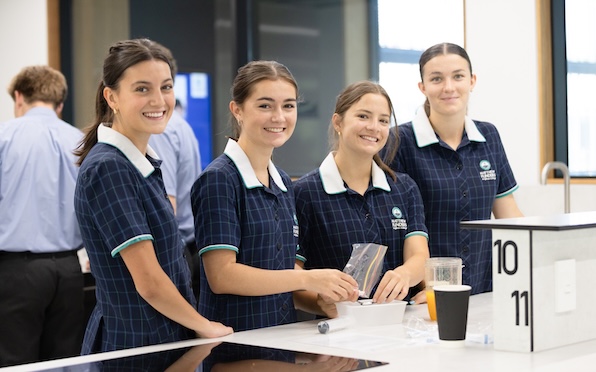
This strong STEM engagement is supported by the College’s investment in outstanding learning environments, with the new Primary Science Lab and Secondary Science Precinct delivered in 2025 as part of the Flinders Master Plan.
The Secondary Science Precinct brings together 12 contemporary laboratories into a purpose-built hub designed for experimentation, collaboration and innovation.
These facilities enable students to experience science as it is practised in the real world.
STEM Learning Through Curriculum and Co-Curricular Opportunities at Flinders
At Flinders, STEM learning extends beyond the classroom through a diverse range of curriculum and co-curricular opportunities.
In 2026, the College introduced weekly after-school UCAT preparation classes to support students aspiring to careers in medicine and health sciences, while also building critical thinking and problem-solving skills.
There is also a weekly training session over three months leading up to the Da Vinci Decathlon Club for Years 7 to 12 to learn how to compete across the competition’s 10 disciplines: engineering, mathematics and chess, code breaking, art and poetry, science, English, ideation, creative producers, cartography and legacy.
Flinders students also participate in immersive experiences such as the University of Queensland Chemistry Program and the Kawana Waters Medical Immersion Program, gaining hands-on exposure to real-world science and healthcare.
Inspiring Girls in STEM
At the same time, the AMSI reports found that women remain underrepresented across STEM pathways, with only 15% of the STEM workforce being female and few engineering graduates remaining in the profession long term.
Supporting greater participation of girls in STEM is a key priority at Flinders.
This commitment was evident at the 2025 Inspiring Women in Science and Health (I-WISH) conference, hosted on campus for the fifth year as a highlight of National Science Week. The event involved 75 Flinders students from Years 10 to 12, alongside a further 20 invited students from local schools.
In 2025, the I-WiSH model also expanded interstate, with conferences hosted by Pymble Ladies College in Sydney and St Catherine’s in Melbourne within their own communities. Both schools had benefitted from participation and mentoring at the Flinders I-WiSH in 2024, led by Dr Louise McCuaig, the Director of the Flinders Discovery Institute at Matthew Flinders Anglican College.
The I-WiSH program is further strengthened by an exciting new partnership connecting Flinders and the Sunshine Coast Health Institute (SCHI) to support students with mentors, real-world pathways and inspiring role models.
The 2025 I-WiSH highlights included a keynote from Professor Alison Jones, Executive Director of SCHI, who encouraged students to pursue their passions and shape the future of science and health, and a presentation from Year 12 student Darcy Brown, who shared her vision for developing climate-resilient crops.
Inspiring Curiosity from the Early Years
The foundations of this success begin early. Primary students engage in hands-on science through programs such as Street Science and inquiry-based learning through the College’s bespoke Impact program, exploring ecosystems, life cycles and environmental challenges alongside parents and carers.
From the early years through to graduation, students are encouraged to explore, question and innovate. The aim is for students to build the skills, confidence and curiosity to become the scientists, engineers and problem-solvers of the future.
